
Powered By



“When I sleep on my back, I stop breathing a lot, and my oxygen levels drop. My doctor is concerned about how my low oxygen affects my heart and blood pressure.” That’s how one MySleepApneaTeam member described what they learned from overnight testing.
Low oxygen levels during sleep are one reason doctors may use testing to understand sleep apnea better. Pulse oximetry is one test that uses a sensor to measure oxygen saturation, or how much oxygen is in the blood.
Keep reading to learn more about pulse oximetry, how it works, and what results could mean about your sleep apnea. You’ll also learn ways to get accurate readings when monitoring oxygen levels at home.
Sign up to view the results!
 Continue with Facebook
Continue with Email
Continue with Facebook
Continue with Email
A pulse oximeter is a small device that measures your blood oxygen saturation (SpO2). They aren’t painful to wear and are often attached to the finger, forehead, or earlobe.
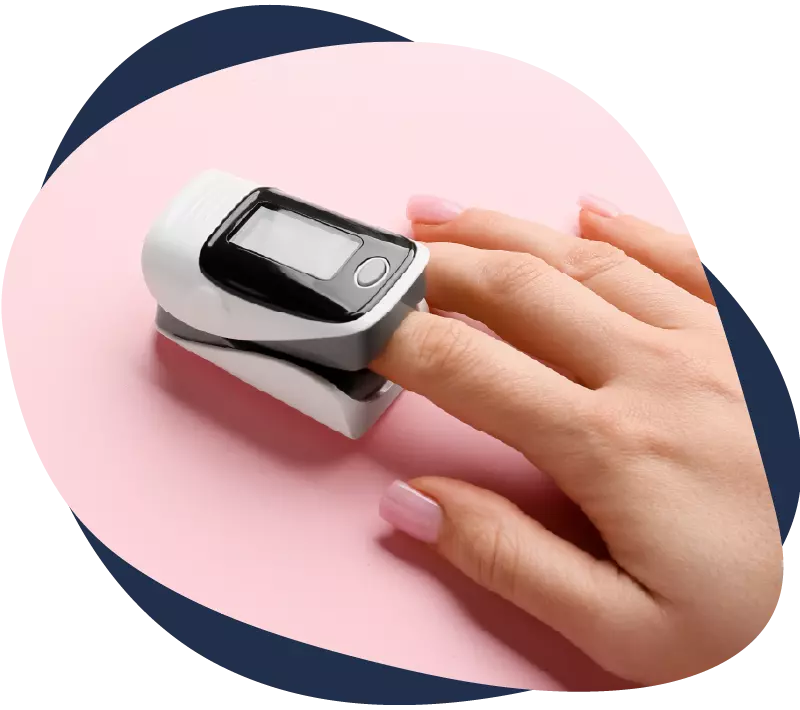 Pulse oximeters work by shining two wavelengths of light through the skin. Oxygenated and deoxygenated blood absorb the light differently. The sensor uses these differences to estimate blood oxygen saturation.
Results are shown as a percentage on a screen, often next to your heart rate in beats per minute (BPM). The higher the percentage, the more oxygen is in the blood.
If you have obstructive sleep apnea (OSA), your upper airway collapses and blocks airflow. This can cause symptoms such as snoring, gasping, and pauses in breathing. The reduced airflow can also cause blood oxygen levels to drop. A doctor may order an at-home or lab sleep study to monitor symptoms and blood oxygen levels, which helps them determine how best to care for your condition.
During these lab studies, lab technicians watch for signs and symptoms while you sleep, including snoring or breathing pauses. At-home studies record the oxygen levels throughout the night. They use continuous overnight pulse oximetry to watch oxygen levels alongside other measures, which helps them understand how severe your sleep apnea may be.
Your doctor may also recommend daytime or overnight pulse oximetry (at home or in a lab) if you have overlapping breathing-related conditions, especially if you’re on oxygen therapy. Conditions may include chronic obstructive pulmonary disease (COPD) or heart failure.
Normal oxygen saturation levels are between 95 percent and 100 percent in healthy people. Blood oxygen saturation under 90 percent is considered low and is called hypoxemia. This is different than hypoxia, which is when too little oxygen reaches the body’s tissues.
During overnight pulse oximetry, doctors look at results from a few different angles to fully understand your sleep apnea. Low oxygen levels can affect your heart, lungs, and blood pressure, so it’s important to learn how severe the symptoms are and how best to treat them.
Here’s what they measure and what each measurement can mean, although combined results paint a more accurate picture.
 Average Oxygen Saturation
The average oxygen saturation is based on readings throughout the night. This number can help doctors identify signs of a possible cardiopulmonary (heart and lung) problem.
In healthy people, the normal average oxygen saturation during the night is 96 percent. Lower averages may mean that oxygen saturation drops often or stays low for longer periods during the night. In OSA, low oxygen levels are related to airflow problems.
Lowest Oxygen SaturationThe lowest oxygen saturation is the lowest result recorded during the night. This number can also give doctors clues about a possible cardiopulmonary issue, but one reading alone doesn’t confirm sleep apnea or another condition.
In healthy people, oxygen saturation generally stays above 90 percent during sleep. In people with OSA, results can be as low as 60 percent to 70 percent.
Oxygen Desaturation IndexThe oxygen desaturation index (ODI) measures how many times per hour of sleep your blood oxygen level drops by a certain amount, often 3 percent or 4 percent. Higher ODI scores may indicate more frequent breathing disruptions during sleep.
There isn’t one agreed-upon cutoff for an abnormal ODI. Some studies have used cutoffs of five, 10, or 15 desaturations per hour. More frequent oxygen desaturation events are linked to a higher apnea-hypopnea index (AHI). The AHI is used to categorize OSA severity by counting how many times breathing slows or stops during an hour of sleep.
Time Under 90 Percent Oxygen SaturationTime under 90 percent oxygen saturation (T-90) measures the percentage of sleep time when blood oxygen levels are below 90 percent. Unlike the oxygen desaturation index, which counts how often oxygen drops, T-90 shows how long oxygen remains low.
Growing research shows that T-90 can help clinicians understand hypoxic burden, or the overall effect of low oxygen levels during sleep. T-90 looks beyond how often oxygen levels dip by showing how long oxygen levels stay below 90 percent.
In people with sleep apnea, a higher T-90 means more time is spent with oxygen saturation below 90 percent. High T-90 is also related to more severe AHI and related abnormal breathing episodes.
Below are T-90 levels and related hypoxemia severity:
Oxygen Saturation PatternsMany clinicians also study waveform patterns of oxygen saturation overnight. These patterns appear on a chart with peaks and valleys representing changes in oxygen levels.
In healthy people, the chart shows steady oxygen saturation above 90 percent. With OSA, one typical pattern is episodes of low oxygen that happen at the same time as rapid eye movement (REM) sleep or while sleeping on your back.
REM sleep supports brain function, the nervous system, and the heart. OSA that occurs during REM sleep is linked to heart health and metabolic problems, including type 2 diabetes.
Factors affecting light and blood flow during pulse oximetry can cause inaccurate readings. A few possible reasons include:
Skin color can also affect light absorption. Research suggests some devices may overestimate oxygen saturation for people with dark skin tones by about 2 percent. More research is needed to develop more accurate devices across all skin tones.

If you haven’t already undergone a sleep study with overnight pulse oximetry, or if you feel that your symptoms have changed and you may need another one, talk to your doctor.
Some over-the-counter pulse oximeters have built-in data tracking, but most are not cleared by the U.S. Food and Drug Administration (FDA). At-home pulse oximetry shouldn’t replace overnight testing with hospital-grade equipment prescribed by a doctor.
Formal sleep studies look at multiple factors that pulse oximeters alone can’t, like airflow, chest movement, and even brain activity in a lab setting.
Talk to your doctor about what to expect. Some MySleepApneaTeam members felt nervous before their sleep studies. One wrote that they found the process strange at first, but ended up better than expected.
“I did mine at home and placed all the things on my chest. I was worried that I would pull off the equipment during the night. It wasn’t as uncomfortable as I thought it might be,” they wrote.
Another performed theirs in the lab because they had mixed sleep apnea. “It was actually really simple. You get all the results soon after, like my oxygen levels, how much I move and breathe, and my sleep stages,” they said.
 On MySleepApneaTeam, people share their experiences with sleep apnea, get advice, and find support from others who understand.
What were your nighttime oxygen levels when you were diagnosed with sleep apnea? Let others know in the comments below.
Get updates directly to your inbox.



 Continue with Facebook
Continue with Email
Continue with Facebook
Continue with Email
Continue with Facebook
Continue with Email
Continue with Facebook
Continue with Email
Become a member to get even more





 Join
Join

 Your Privacy Choices

This is a member-feature!
Sign up for free to view article comments.
We'd love to hear from you! Please share your name and email to post and read comments.
You'll also get the latest articles directly to your inbox.